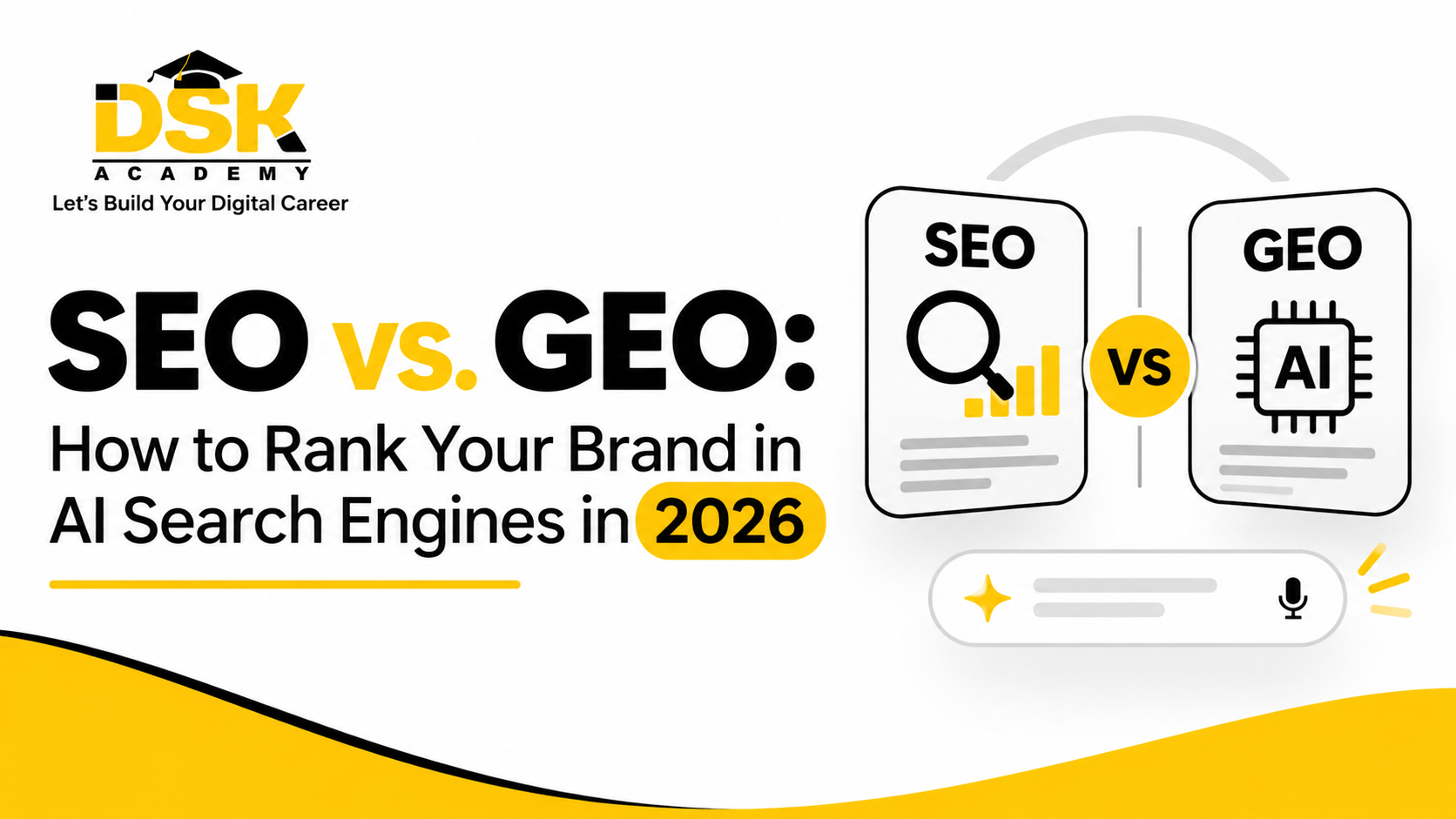
SEO vs. GEO: How to Rank Your Brand in AI Search Engines in 2026
Search a question on Google today and the first thing you often see isn’t ten blue links. It’s an AI-written answer, with a few sources tucked beside it. If your brand isn’t one of those sources, you’re missing from the part people actually read. That’s the shift behind Generative Engine Optimization (GEO), and it’s why almost every list of SEO trends 2026 puts it near the top.
What is Generative Engine Optimization (GEO)?
GEO is the practice of making your content and brand easy for AI tools to pick, quote and name in their answers. Those tools include Google AI Overviews, ChatGPT, Perplexity, Gemini and Copilot. Classic SEO asks, “How do I rank higher in the list?” GEO asks, “How do I get mentioned in the answer?”
You’ll also hear Answer Engine Optimization (AEO). The two overlap a lot. AEO is usually about being the direct answer, as in featured snippets, People Also Ask boxes and voice results. GEO goes a step further and covers how AI tools describe your brand across a whole conversation. In practice, one plan covers both, and many people simply call it AI search optimization.
SEO vs. GEO: what actually changes
| SEO | GEO | |
|---|---|---|
| Goal | Rank pages in search results | Get cited and recommended in AI answers |
| Unit of work | The page | The answer, the passage and the brand |
| Main signals | Keywords, backlinks, technical health | Clear answers, brand authority, mentions on other sites, fresh content |
| Success looks like | Rankings and clicks | Citations, brand mentions, AI-referred visits |
The biggest change is that a click is no longer the only win. Sometimes the AI answer names your brand and the user never visits your site. That still counts as visibility, so it deserves a place in your reporting.
Does SEO still matter? Yes, but not on its own
Good news first: SEO is the base. Fast pages, clean structure, schema and crawlable content help both SEO and GEO.
But ranking first doesn’t guarantee a mention. Ahrefs found that only about 38% of pages cited in Google AI Overviews come from URLs in Google’s top 10 results (as reported by Adweek). One 2026 study of 57 million AI citations also found that brands own only around 10% of them. The rest go to media sites, review platforms, forums and other third parties. So what others say about you matters as much as what you say about yourself.
How to rank in AI Overviews and other AI tools
- Answer the question first. Under each question-style heading, give a clear two or three sentence answer, then add detail. AI tools pull short, complete passages.
- Add facts and sources. Researchers from Princeton and IIT Delhi found that adding citations and statistics to content raised visibility in AI answers by up to 40%.
- Build a consistent brand. Use the same name, address, description and profile details across your website, Google Business Profile, LinkedIn and directories. AI tools trust what matches.
- Earn mentions beyond your site. Reviews, Quora and Reddit answers, YouTube videos, news coverage and guest posts all give AI tools more places to find you.
- Use structured data and keep pages fresh. Add Article, FAQ and Organization schema, show a “last updated” date and refresh old statistics.
- Track it. Once a month, ask ChatGPT, Perplexity, Gemini and Google the questions your customers ask. Note whether you appear and who does instead.
Is it worth the effort yet? An honest look
AI referral traffic is still small. Conductor’s 2026 benchmark put it at roughly 1% of site visits, as reported by industry blogs. Yet eMarketer reports that 94% of marketing leaders plan to spend more on GEO this year, while most still don’t measure it.
Our reading: it’s early, and starting is cheap. Most of the work is good SEO plus clearer writing and stronger brand presence. Just be careful with anyone who promises you the top spot in ChatGPT. AI answers change fast, and nobody controls them.
What this means if you’re learning SEO
If a syllabus is all keywords, backlinks and meta tags, it’s missing half of 2026. When you compare courses, check for GEO and AEO, schema, brand and entity building, writing for AI answers, and tracking AI visibility, along with practice on real client accounts.
DSK Academy in Mira Road runs a 6-month Master in Performance Marketing & AI-Driven Strategy course with an internship certificate. You train on real client work, and SEO is taught together with AI search rather than as a separate, older topic. The next batch starts on 7 December 2026. Message us on WhatsApp at +91 8433526615 to see the syllabus.